
Yin & Restorative Yoga: What’s the Difference & Which One Should You Do?
Dana Lloyd | MAY 21, 2025
Yin & Restorative Yoga: What’s the Difference,
& Which One Should You Do?
Yin Yoga and Restorative Yoga are two profoundly healing practices that often get lumped together, but they’re actually quite distinct. One is about finding your edge and softening into it. The other is about surrendering completely and being held. They do share a commonality: supportive props! If you'd like help sorting out what you need to support your practice click here for my Soft Power Guide: Yin + Restorative Yoga Props.
Once you understand the differences between these two styles, and how they serve the body and mind, you will be ready to choose the practice that supports you the most in the moment.
What is Yin Yoga?
Yin Yoga is a slow, meditative practice that targets the deep fascia, joints, and connective tissues of the body, particularly in areas like the hips, pelvis, and lower spine. But it’s more than just physical. It’s a practice rooted in Taoist philosophy, designed to balance the body’s energetic systems and bring a sense of deep inner stillness.
A Little History:
Yin Yoga as we know it today was introduced to the West in the 1970s and 80s. Teachers like Paulie Zink, and later Paul Grilley and Sarah Powers andapted Eastern traditions for modern practice. Grilley, who studied anatomy and Daoist theory, emphasized how long-held poses could stimulate the body’s meridian lines, much like acupuncture or acupressure.
Yin & Yang Energy:
In Taoist tradition, yin represents stillness, darkness, and introspection. In contrast, yang, represents activity, light, and heat. Our fast-paced world (and most forms of exercise, including Vinyasa Yoga) are yang-dominant. Yin Yoga offers a counterbalance, stillness to soothe the over-stimulated body and mind.
Meridian Theory & Energy Flow:
Yin Yoga postures are believed to activate the meridian channels used in Traditional Chinese Medicine. These are energetic pathways that relate to organs like the liver, kidneys, and lungs. By compressing or stretching certain areas, Yin Yoga encourages qi (life force energy) to flow more freely, supporting both physical and emotional health.
What to Expect in a Yin Class:
Poses are held for 3 to 7 minutes, often seated or reclined.
Props may be used, but the focus is on functional alignment, not aesthetics. (prop guide here)
The breath is slow and steady, and you’re invited to stay present with sensation.
Movement is minimal. The experience is more about being than doing.
Benefits of Yin Yoga:
Improved joint mobility and connective tissue health
Enhanced emotional resilience and energetic balance
Stimulation of the meridian system for internal healing
A deeper capacity for stillness, mindfulness, and self-inquiry
What is Restorative Yoga?
Restorative Yoga is all about deep rest. This gentle practice soothes the nervous system, helps release tension, and allows the body to return to a natural state of balance and ease. Developed and popularized by Judith Hanson Lasater, a student of B.K.S. Iyengar, Restorative Yoga grew out of the idea that support and stillness create the most potent conditions for healing — especially in times of stress, grief, or burnout.
What to Expect in a Restorative Class:
Poses are fully supported with blankets, bolsters, blocks, and eye pillows. (prop guide here).
You might hold each pose for 5 to 20 minutes or more.
There’s no stretch, no sensation — just pure rest and release.
Breathing is soft and natural; often guided into deep parasympathetic relaxation.
Benefits of Restorative Yoga:
Reduced stress, anxiety, and insomnia
Support for recovery from injury or illness
Calming of the nervous system and immune support
A space for emotional processing and inner peace
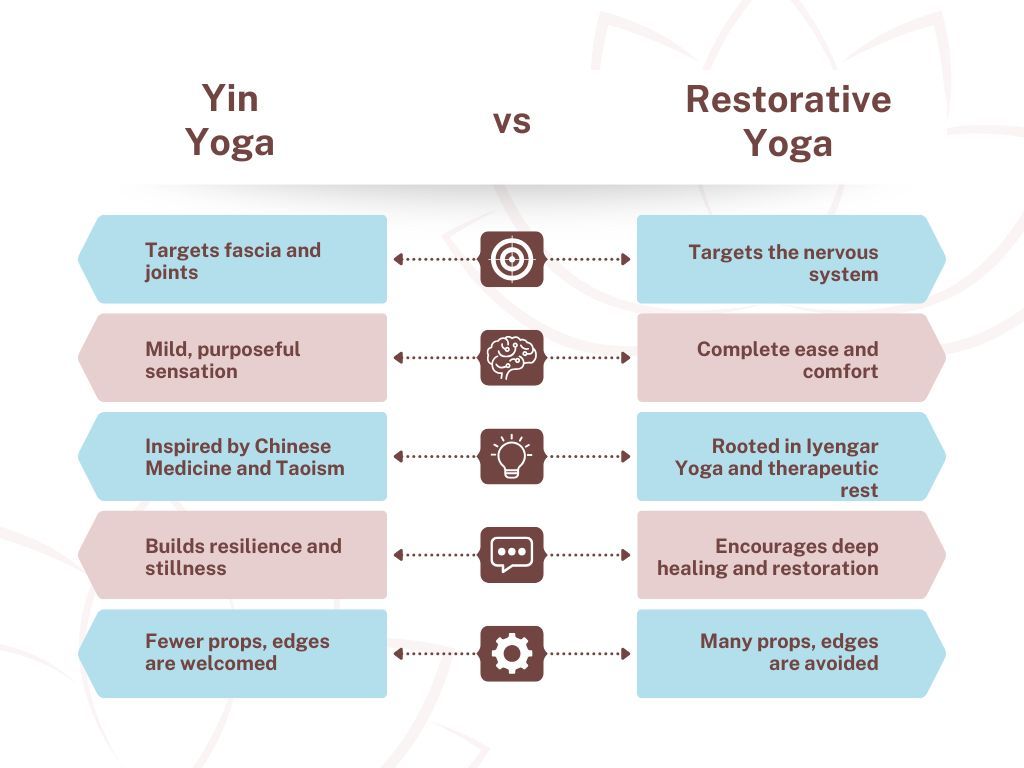
Key Differences Between Yin and Restorative Yoga
Which Style is Right for You?
Yin Yoga is especially supportive if you:
Want to improve flexibility and joint mobility
Are looking for a mindful challenge without intensity
Feel emotionally stuck and want to encourage energetic flow
Enjoy being still but crave a bit of inner engagement
Restorative Yoga may be exactly what you need if you:
Are experiencing fatigue, overwhelm, or burnout
Need gentle, nervous system recovery
Are grieving, healing, or living with chronic conditions
Long for complete rest in a soft, supported space
Can’t Decide? Try Both. Here’s Why.
You don’t have to choose one. In fact, many practitioners (and teachers!) find that a combination of Yin and Restorative Yoga creates the perfect rhythm. Some days your body needs gentle challenge and space. Others, it simply needs to be held.
Yin and Restorative don’t compete, they complement each other beautifully. Try both and notice how your body, energy, and mind respond. Your intuition will guide you from there.
Your Wellness Journey. Your Choice.
There’s no hierarchy here. Yin and Restorative Yoga both offer access to presence, healing, and deep inner knowing. One invites you to stretch into your edges. The other reminds you it’s okay to rest completely.
You don’t need to rush. You don’t need to decide forever. Just begin. Explore. Trust that your body will show you the way.
Dana Lloyd | MAY 21, 2025
Share this blog post